
If your sales pipeline is not converting the way it should, deals are stalling at the same stage month after month, or sales and marketing keep arguing about who to go after, the odds are that nobody in the business can agree on what an ideal customer actually looks like. The quickest way to find your ideal customer profile is to stop guessing and start with the customers who have already bought from you and got real value, rather than another conference-room exercise about who might need your software one day.
A useful ideal customer profile for SaaS is more than an industry, a company size and a job title. It describes the businesses where an Economic Buyer has the budget, the urgency and a set of pains serious enough to make action matter now.
Broadly relevant is commercially invisible.
01. Start with evidence, not a profile template
An ICP built from assumptions is a description of what your team hopes is true. It may sound plausible, but that does not make it commercially useful.
Instead, reverse-engineer your best actual customers. Look for the accounts that bought, adopted the software, achieved value and were a good fit for the business to serve. A large contract is not automatically a good-fit customer if implementation was painful, the sale depended on unusual effort or the account did not get lasting value.
Begin with what you can verify: who signed, what was happening in the business when they started looking, what problem they needed to solve and how the software fitted their organisation. Then check whether similar conditions show up across several good customers.
That pattern is your starting hypothesis, not yet a rule for every future opportunity.
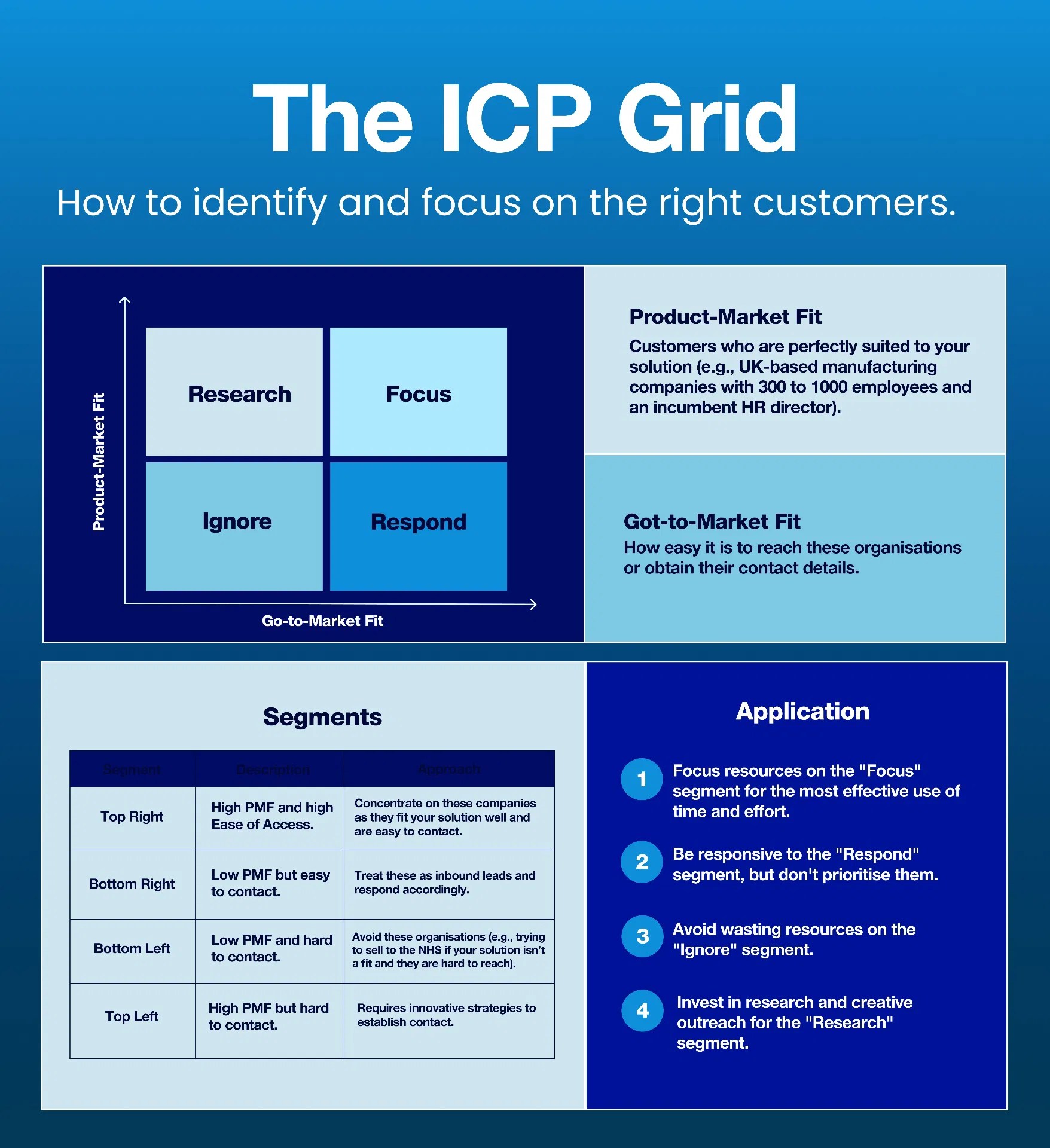
The ICP Grid is a useful reminder that a strong customer fit is not the only consideration. You also need a practical way to reach and serve those companies. A segment can be an excellent product fit but difficult to contact. Another may be easy to reach but a poor fit. That tension is exactly what you have to weigh when deciding where to focus your time.

02. Define the conditions for a buying decision
Firmographics belong in an ideal customer profile for SaaS. Industry, company size, geography and business model can help you identify relevant accounts. But they do not explain, on their own, why a company will buy.
A more useful profile connects the account to the buying conditions:
- Economic Buyer: Who has the authority, budget and business responsibility to approve a purchase?
- Perfect Customer: What kind of organisation is most likely to get clear value from your product?
- Visceral Pains: Which urgent problems create a reason to act rather than wait?
- Decision criteria: What must the buyer believe or verify before approving a solution?
- Decision process: Who else evaluates, influences or can block the purchase?
In every B2B sales strategy worth the name, the hard part is understanding how the decision actually gets made rather than simply finding a contact. The person who first engages with your team is rarely the one who controls the budget, and qualification means learning how the problem, the authority and the decision path connect before you commit real selling time to it.
Customer pain points in B2B SaaS need the same level of specificity. “They want to be more efficient” is not enough. What is happening in the business? What does it cost in time, revenue, risk or missed targets? What has changed to make the problem worth solving now?
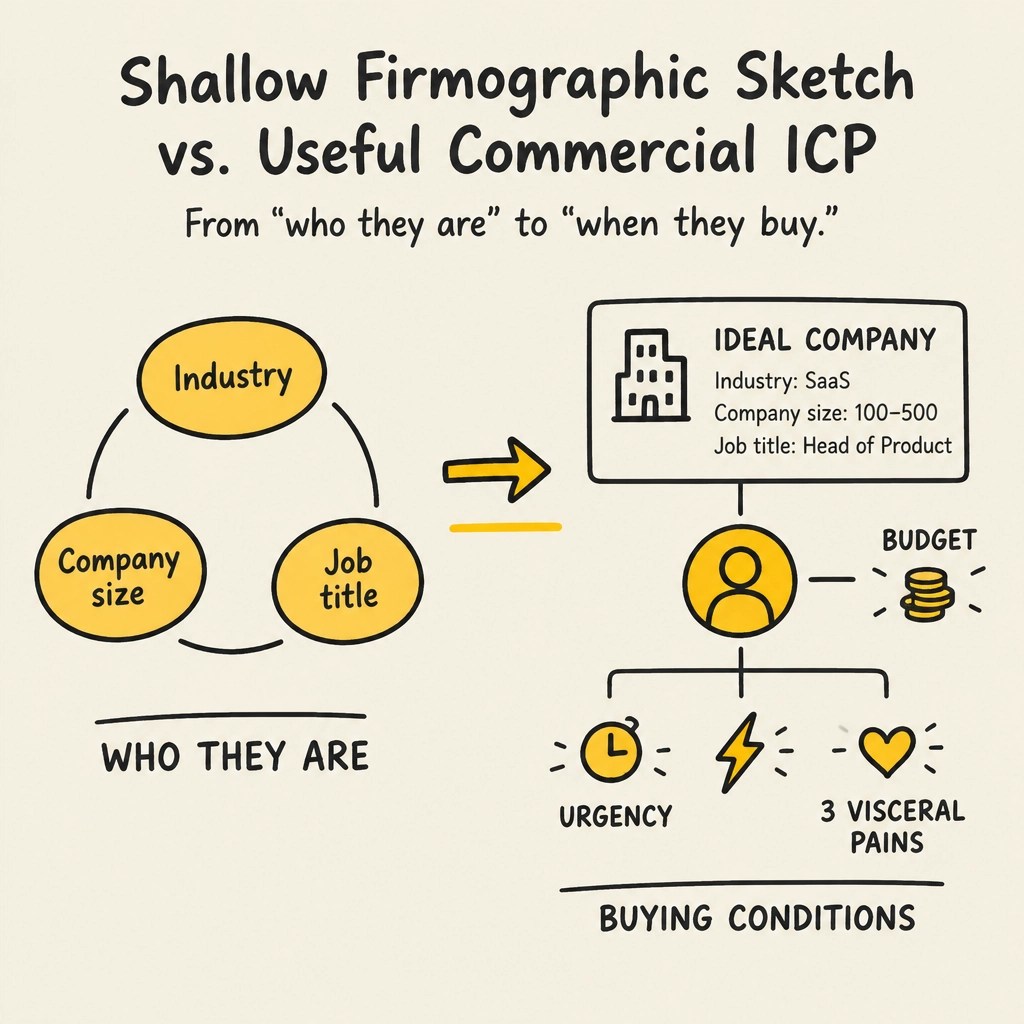
A company profile can tell you who might be relevant. Pain, urgency and budget help you assess whether there is a reason to buy.
03. Run the 10–20 deal diagnostic this week
Pull your last 10–20 closed-won deals. If you have fewer, use the deals you have, but treat any pattern as provisional. For each one, write down:
- Who signed? Identify the Economic Buyer, not just the first contact.
- What was the company like? Note the characteristics that seem linked to getting value, not every detail in the CRM.
- What triggered the search? Look for the event or pressure that made the problem harder to ignore.
- What was the pain? Capture the buyer’s words, the consequence of doing nothing and what they had already tried.
- How did the decision happen? Record the people involved, important decision criteria and the route to approval.
Then compare the answers. Which traits recur among the customers who were easiest to help and strongest in fit? Which are different from the deals that dragged on or proved hard to serve?
Finally, compare those patterns with your current marketing and prospecting. Are your campaigns aimed at the accounts that share the evidence, or at a much broader group that merely looks possible?
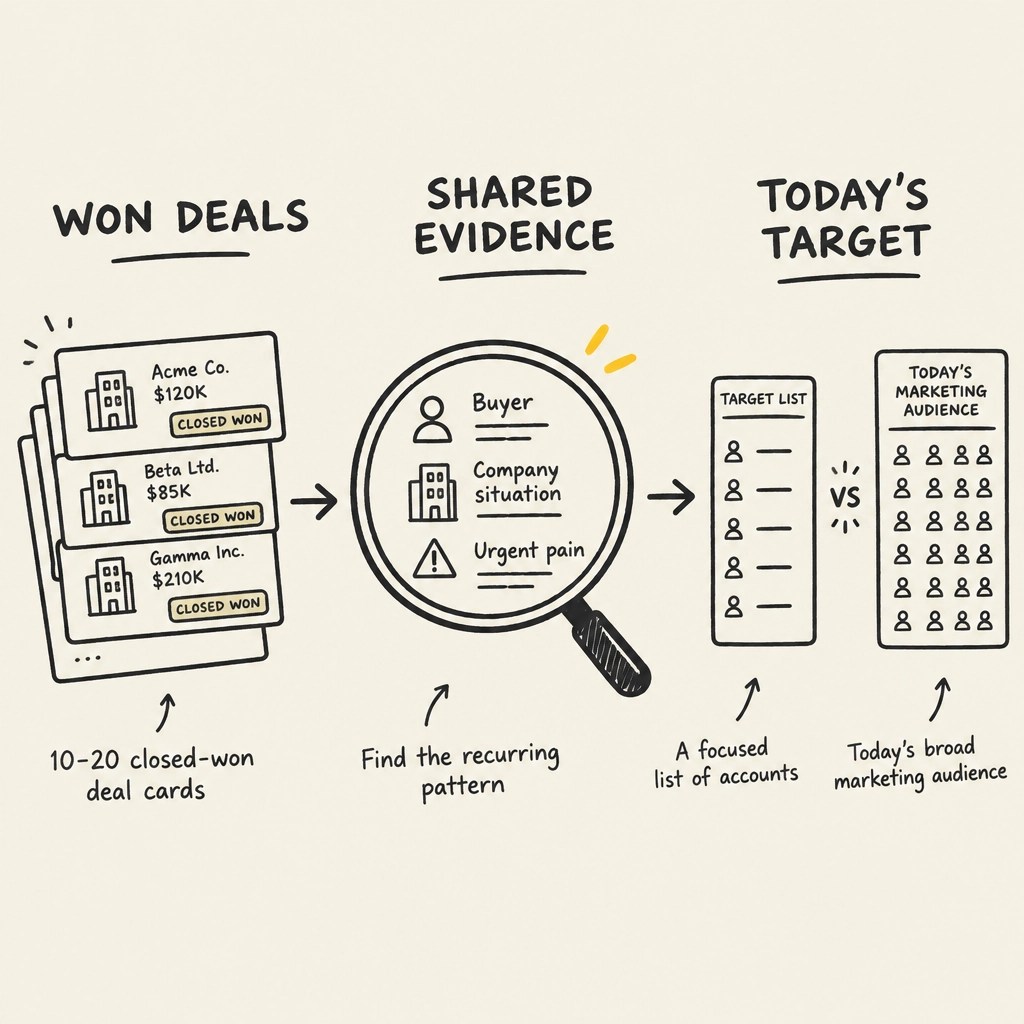
This is not a statistical model. It is a disciplined way to expose where conviction has outrun evidence. In the exercise, keep observed facts separate from assumptions. “The COO approved the budget” is a fact. “Companies in this sector always have budget” is a claim to test.
04. Turn the pattern into a usable ICP
A useful ideal customer profile template should help your team make decisions, not just fill a slide. Try writing your current hypothesis in one sentence:
Our software is best for [type of company in a specific situation], where [Economic Buyer] is dealing with [three urgent business pains] and has a clear reason to act now.
Then add a short set of qualification questions:
- Is there a material problem your software is suited to solve?
- Does the Economic Buyer own, or have access to, the relevant budget?
- Is there a reason to address the problem now?
- Can the customer meet the key decision criteria and complete the decision process?
- Can your team help this customer achieve value without exceptional effort?
Include “not a fit” conditions, too. Perhaps a certain business stage cannot support implementation, a particular use case needs capabilities you do not have, or there is no route to the budget owner. A profile that cannot rule anything out is not precise enough to guide action.
Do not treat the first draft as a permanent definition. Validate it against new opportunities. Compare the quality and progress of deals that match the profile with those that do not. If your best customers contradict the hypothesis, update it. Concentration comes before expansion; repeatability comes before scale.
05. Put the profile to work across the team
An ICP only matters if it changes decisions, and every go to market strategy for SaaS is built on the back of one. Sales should use it to qualify and prioritise opportunities. Marketing should use it to choose audiences and speak to the pains that prompt action. Product should understand which customers benefit most, and which requests do not justify expanding the roadmap.
This shared evidence also helps break the internal blame loop. If sales says leads are poor and marketing says sales is not following up, compare both views with the customer pattern. Are the right companies entering the pipeline? Do buyers recognise the problem in your message? Can the sales motion reach the Economic Buyer and support their decision criteria?
Vencha’s work with founders is built around testing these commercial assumptions rather than treating a profile as a document to complete. Barb Hyman, Founder of Sapia.ai, describes Vencha as an environment where she can “spitball ideas, war-game different strategies and have my thinking challenged” (client results). The value of that challenge is practical: replace internal conviction with evidence the team can act on.
Find the pattern before widening the market
Your ICP is not the biggest group that could use your product. It is the specific set of companies where the right Economic Buyer faces urgent Visceral Pains, has a route to a decision and can get real value from what you sell.
This week, review your last 10–20 wins and compare their shared characteristics with your current target audience. Write down the gaps. That is a better starting point than making the profile broader to keep every possible market in play.
If you want to turn that evidence into a sharper customer profile, use Vencha’s free Selling Software Algorithm Builder. It helps you define your Economic Buyer, Perfect Customer and Visceral Pains, then turn them into practical prospecting criteria.
And if you want the complete system behind all of this — the four strands of Perfect Customer DNA, the buying conditions behind every sale, the 10 to 20 deal diagnostic and the ICP Grid — it's all in The Selling Software Algorithm: The Go to Market Navigation System for B2B Software Leaders by Richard Blundell, Paul Watson and Chris Tottman, available on Amazon.
Missing your sales targets?
Tell us what’s not working and we’ll help you find out why.