
If your pipeline is thin, your sales cycles drag on longer than they should and the team can't agree on which accounts to chase, it's worth asking the question nobody enjoys: are we actually selling to the right companies? An ideal customer profile (ICP) is supposed to answer that, but in most B2B software businesses it doesn't, because "ideal" leaves too much room for interpretation. In The Selling Software Algorithm, the answer is something we call a Perfect Customer Profile, and the deliberate choice of the word "perfect" rather than "ideal" is where the value sits.
The trouble with "ideal" is that it's too forgiving. It leaves room for every plausible prospect, every edge case, and every "well, they could probably use it too", and that ambiguity is expensive because it spreads your sales effort too thin. Perfect, by contrast, forces a choice. This guide walks through how to define your ideal customer profile perfectly — by taking it to the centre of the dartboard.
1. Why perfect beats ideal
An ideal customer profile (ICP) is the description most B2B software teams start with, usually built from a sector, a company size and a job title. Perfect isn't a claim that some organisation has no flaws, and it isn't a trophy you award to your favourite customers. It's a forcing function, one that asks you to define the centre of the bullseye: the customers where fit, urgency and your ability to win all come together at once.
The book uses a dartboard to make the point. Ideal customers sit somewhere between the treble beds and the bullseye, close enough to feel comfortable but rarely at the centre, whereas Perfect Customers sit at the middle pixel of the middle dot. What makes that precision so useful is that it cuts both ways: once you've defined who belongs in the bullseye, you also know who's out, your qualification sharpens, and Sales, Marketing and Product finally have a basis for decisions that doesn't turn every meeting into a shouting match.
The full Selling Software Algorithm brings three things together:
Our software is perfect for [a clearly defined and understood Economic Buyer] in [a tightly defined Perfect Customer Profile] who is struggling with [the three most visceral business pains our software solves].
The profile is one part of that sentence, not a list of everyone who might, conceivably, use the product.
2. Find the knife
As software develops, too many new features accumulate and the product solves more problems than it did at launch. This sounds like a strength right up until your pitch leads with every capability and buyers are left working out for themselves what actually matters. That's the Swiss Army knife trap: the more you offer, the more the Value Proposition blurs.
Every product has a knife, meaning the one capability that most changes the customer's world, and finding it means listening for the business outcome customers value rather than the feature your team finds most impressive.
Take Jack's business, which was selling into retail. A Head of Retail Operations told them, "Before this, to be honest, we were flying completely blind", and that one sentence was worth more than any feature audit they could have run, because it pointed straight at the knife: real-time visibility across stores.
The team narrowed its focus to mid-enterprise retail operations, the message became specific, the roadmap simplified and the sales motion turned repeatable, and revenue doubled within six months. Your results will vary, of course, but the underlying lesson holds: focus gave Jack's team a clearer place to learn and to sell.
3. Map your Perfect Customer DNA
A profile is more than a sector and a company size. In the book, we describe the conditions that make value likely through four dimensions of Perfect Customer DNA.
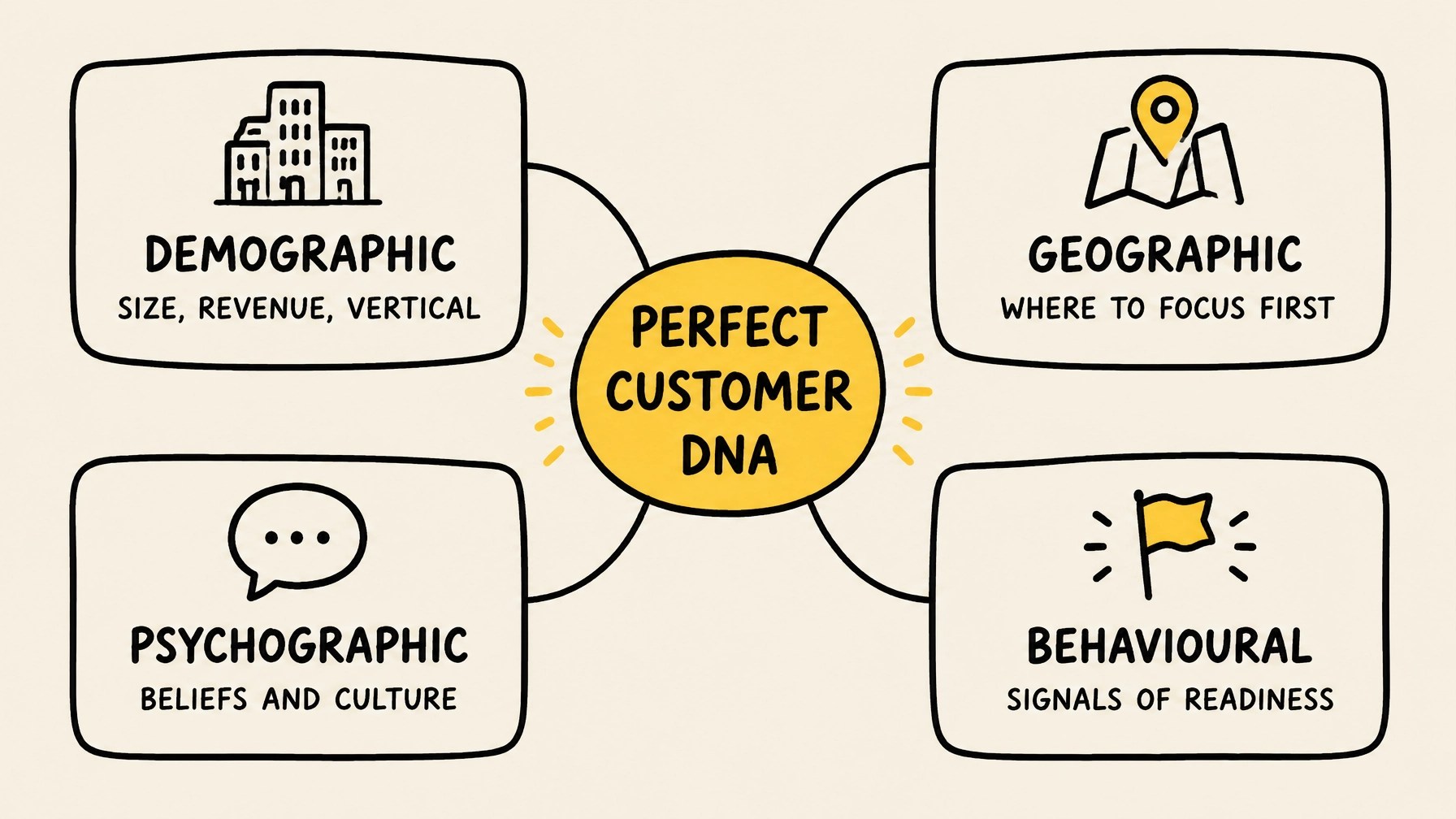
Demographic fit
Start with the structural conditions: size, revenue band, funding stage, vertical and business model, which together tell you whether the organisation has the scale, complexity, budget and operating conditions to benefit from what you sell. Not every company that could use your software is a company that should buy it today.
Geographic fit
Decide where you can sell, serve and learn effectively, because geography is a sequencing decision rather than a life sentence. Start where proximity, market knowledge or existing relationships help you learn faster, and earn the right to expand later.
Psychographic fit
Consider what the organisation believes and how it makes decisions: does it prize innovation and speed, or control and predictability, and how strongly is it shaped by compliance or risk? When an organisation's values align with the way your product creates value, sales happen more naturally, and when they don't, even a good product fit meets resistance.
Behavioural fit
Look for evidence of readiness: a new COO with a transformation mandate, a funding round, Board-level AI discussions, or a visible shift in adoption patterns. These signals don't prove a company will buy, but they separate a plausible fit from a business with a reason to act now, because intent reveals readiness.
Say your profile reads: mid-market healthcare services, 1,000–3,000 employees, £250m–£750m turnover, multiple sites, regulated operations, with Board-level focus on AI or automation. That's fine as long as customer evidence supports every number, so don't copy a profile simply because it looks precise.
4. Ask what MUST be true
The most useful profile has non-negotiables, so ask your team the question the book insists on:
What MUST be true for this customer to receive clear value from our software, and for us to sell and deliver that value well?
Keep refining until you can say the answer in one clean sentence, because if the sentence still contains "and other similar businesses", "any organisation looking to…" or a string of exceptions, the profile isn't finished.
You can run a simple diagnostic this week. Pick three customers you'd genuinely want to clone and, for each one, write down:
- What urgent problem made them look for a solution?
- Who owned the decision, and what was at stake for them personally?
- What conditions made implementation and value possible?
- What evidence said they were ready to act?
- Which customer or product outcome would you want to repeat?
Now compare the answers and look for recurring evidence rather than the traits your team assumes should matter. The shared pattern may be narrower than your current ideal customer profile, and it may also expose a customer segment that's easy to reach but rarely gets full value.
If you'd like a template to work from, the book's ICP Grid and the Selling Software Algorithm Builder both take you through this step by step.
5. What a finished profile looks like
It helps to see one. In the book, we bring all of that work together in a single paragraph that feels concrete, human and commercially grounded, and it reads like this:
Our Perfect Customer is a mid-market healthcare services organisation, typically employing between 1,000 and 3,000 people and generating £250m to £750m in annual revenue, operating across multiple sites in the UK or Northern Europe. They're led by an Economic Buyer who has been tasked with improving efficiency, compliance and reporting without increasing headcount, and who wants to be seen internally as someone who modernised how the business runs. They value innovation but operate in a regulated environment, meaning trust, reliability and defensibility matter deeply. They're actively exploring automation and AI, feel increasing pressure from fragmented data and manual processes, and are motivated to act because the current state is creating frustration, risk and repeated leadership scrutiny.
Notice what that paragraph does. It weaves all four strands of the DNA together — the demographic and geographic spine, the belief system of the leadership team, and the behavioural signals of readiness — and it ends on the pressure that makes action likely rather than optional. There isn't a vague word in it, and there isn't room in it for the companies you hope might buy.
The book's closing instruction is the one to take away: work hard with your team to create something similar. It's disciplined, evidence-led work, and when it's done well, it changes everything that follows. This post covers the strategic half of the method; the full exercise, from the dartboard to the ICP Grid and the Launching Customer Sweet Spot, is in The Selling Software Algorithm: The Go to Market Navigation System for B2B Software Leaders by Richard Blundell, Paul Watson and Chris Tottman, available on Amazon.
A tighter profile doesn't shrink your ambition; it gives you a place to build repeatability before expansion. And once the profile exists, the next moves follow from it: turn it into a Market Map and Face Book, sort your targets with the ICP Grid, and check which prospects are actually ready to buy. Start this week: choose three customers to clone, work out what MUST be true, and turn it into one sentence your team can test.
You can work through every step with the free Selling Software Algorithm Builder.
Missing your sales targets?
Tell us what’s not working and we’ll help you find out why.