
Your Perfect Customer Profile is finished, and it's a good one. The DNA is mapped, the verticals are sized, the psychographic and behavioural attributes are agreed. There's just one problem: none of those businesses are going to ring you up. A list of businesses isn't the same as a list of people, and it's the people who sign the cheque.
That's what the Market Map Face Book is for. It's a most wanted list — a bit like the Wild West posters of old, but yours will live on an internal board or a shared document that nobody outside the business will ever see. Its job is to project into the universe exactly who you need to meet and engage with.
And here's the thing about these people: them saying yes to your software, twenty-five times over, is the difference between where you are today and running a multi million pound business. So it follows that you need to know them deeply. Not stalk them, but get an intimate knowledge of them — deep, deep research. What do they talk about? What are they KPI'd on? Where do they meet?
1. A profile changes nothing until it becomes a list
You should have by now done the strategic work highlighted in an earlier blog and agreed what a Perfect Customer looks like. But if that profile never becomes a list of real Economic Buyers, the business drifts back into opportunistic selling, and the profile becomes a document nobody opens.
The Market Map is a list of organisations that display the attributes of a strong match for your solution. It translates your ideal customer profile into a practical view of the market: which companies belong, which are worth focusing on first, and who you need to reach inside them. If finding your ideal customer profile is step one of a go to market strategy for SaaS, turning it into a named list of accounts and buyers is step two. Get it right and it's often the difference between teams that hope for traction and teams that engineer it.
2. Build the Market Map in three stages
The process begins with a broad list, then narrows through evidence and prioritisation. The numbers below are a useful working model, not a target to hit regardless of your market size or sales capacity.
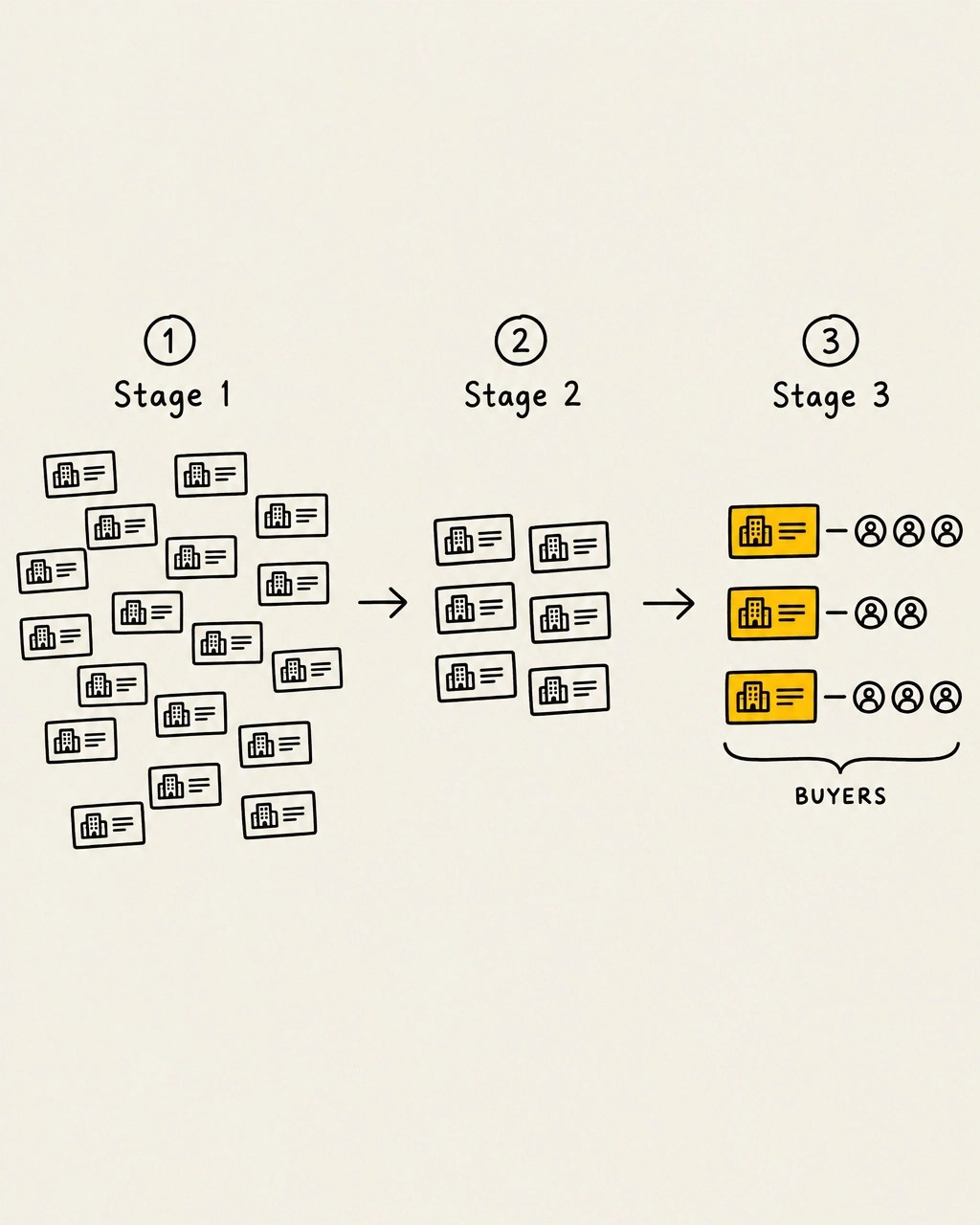
Stage One: build a long list of roughly 500 organisations. Start with structural and contextual fit: the demographic and geographic characteristics in your profile, along with clear signals about company culture, behaviour or technology where you can find them reliably. The specific method matters less than the discipline of applying the same criteria across the whole list.
Stage Two: narrow to roughly 100 Focus accounts. Overlay further signals to identify where fit is strongest and momentum seems most likely. This might include a relevant business event, a technology environment that suits your product, or evidence from existing customers that points to a better chance of value and adoption.
Stage Three: identify the Economic Buyers. Enrich each priority account with the person most likely to hold the economic decision, and usually two or three adjacent decision-makers. Now your list is more than a collection of company names: it is usable, actionable and precise.
An ICP list of companies is useful only when the criteria behind it are clear enough for the team to apply consistently. If two people would make very different decisions about whether an account belongs, the profile needs more work before the list gets bigger.
3. From companies to people: build a Face Book of Economic Buyers
If the Market Map helps you see the battlefield, the Face Book introduces you to the captains and generals fighting on it. For each of your hundred Focus accounts, you find the likely Economic Buyer and you make that person real to the team: name, role, company, face, and increasingly a working knowledge of who they are. In account-based selling terms, this is your target account list with the buyers attached, and it's the difference between knowing the market and knowing the people in it.
In practice, this means building an internal board or shared document with each priority buyer's profile photo alongside their details: pull their picture from LinkedIn and place it with the name, title and company. It sounds almost too simple. It isn't. It's the single most effective way of turning a CRM full of rows into a room full of people you're trying to reach.
The point of the Face Book is intimacy, and it's worth being precise about what that means. When people are just rows in a CRM, it's easy to treat outreach mechanically. When they have faces, careers, histories and public narratives, the tone of your thinking changes. You stop asking "How do we get in?" and start asking "What's happening in their world right now?" You move from generic messaging to informed curiosity, and that's where real conversations begin.
So get curious about them. What do they talk about at conferences and on panels? What are their KPIs this year, and what will they be measured on next year? Where do they meet — which events, which boards, which peer groups? What keeps them up at night? None of this is secret information; most of it is sitting in plain sight in interviews, conference agendas and annual reports. But gathering it and holding it in one place changes how your whole business thinks about those twenty-five yeses.
4. Keep the list focused and alive
The Face Book is not built overnight and nor should it be — the work here is deliberately paced. Treat it as living territory: review the accounts, test whether they still fit, and update the people as you learn more. A large list can feel reassuring, but too many target customers distract the team, and you can't become intimate with two thousand businesses. Obsess about the hundred.
Richard used to put the logos of the companies he most wanted to get into on the wall of the sales team room, so that everybody — whether they were in Sales or not — knew which connections the business was chasing. He never quite knew why, but somehow it increased the odds of meeting those people. It's amazing what that kind of focus can do. The Face Book is simply the modern, easier way of doing the same thing.
Try this diagnostic this week: take the top 20 accounts in your CRM and ask whether someone on the team could put a face, a career history and a current professional narrative to each likely buyer. If not, you may have a company list, but you do not yet have a useful Face Book — and if your B2B sales strategy is producing a pipeline that isn't converting, the gap between a company list and a Face Book is one of the first places to look.
Start with a smaller set, research it properly, and let evidence guide what you add next. If you'd like to see how the Face Book fits into the wider method, read How to Uncover Perfect Customers for your Software, which covers the Perfect Customer DNA that feeds the Market Map. To turn your customer profile into practical prospecting criteria, use the free Selling Software Algorithm Builder.
And if you want the complete system behind all of this — the dartboard, the ICP Grid, the Launching Customer Sweet Spot and the full Market Map and Face Book exercises — it's all in The Selling Software Algorithm: The Go to Market Navigation System for B2B Software Leaders by Richard Blundell, Paul Watson and Chris Tottman, available on Amazon.
Missing your sales targets?
Tell us what’s not working and we’ll help you find out why.